Nigeria Housing Policy 2025: Renewed Hope, But Can It Match Skyrocketing Rents?
Dim Oba writes this piece titled Nigeria Housing Policy 2025: Renewed Hope, But Can It Match Skyrocketing Rents?
Nigeria’s housing reform in 2025, wrapped in the Nigeria Housing Policy 2025 under the Renewed Hope agenda, aims to close a yawning deficit estimated at over 20 million homes. But across states like Lagos and Rivers, the surge in rental prices paints a stark picture of the challenge ahead.
On paper, the policy promises affordable housing, rent-to-own models, and social housing programmes that would reach all 774 local government areas. The federal government and states have begun mapping out Renewed Hope estates along fast-growing corridors—such as Ibeju-Lekki and Badagry in Lagos, and Greater Port Harcourt in Rivers. Infrastructure and land allocations are being fast-tracked to support these efforts.
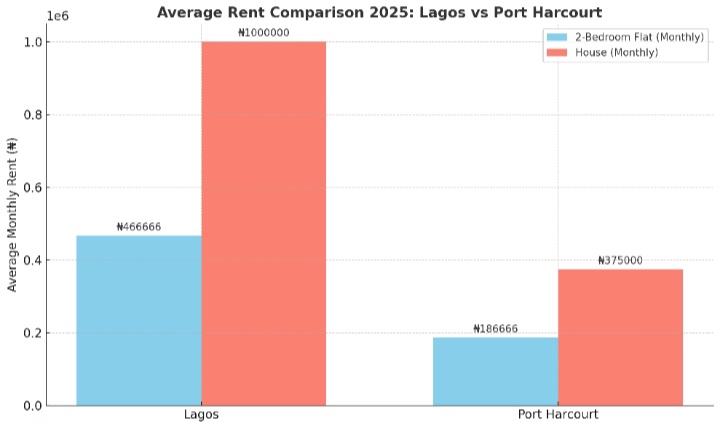
Yet for many Nigerians today, the cost of current rental housing is an immediate burden too heavy to ignore. In Lagos, the average rent for a 2-bedroom flat in 2025 is about ₦5,600,000 per annum . In upscale areas like Victoria Island and Ikoyi, rents range from ₦2,500,000 to ₦5,000,000 and even higher depending on amenities . On Lagos Island, Q1 2025 data showed island apartments rising 41 % year on year . Meanwhile, the average house (i.e., standalone or semi-detached home) in Lagos rents for about ₦12,000,000 per annum .
In Port Harcourt, where housing pressure is intense in city areas like Diobu, Rumuodara, and Federal Light, the rental landscape is more varied but still daunting. The average rent for flats in Port Harcourt is around ₦2,240,000 per annum as of May 2025 . One-bedroom flats typically go for ₦1,400,000 per year on average . Some 2-bedroom units listed in mid-2025 go for ₦1,600,000–₂,000,000 . For houses, 3-bedroom semi-detached duplexes in desirable estates are listed at ₦4,500,000 per annum .
To put these in perspective: a Lagos resident paying ₦5,600,000 annually for a 2-bedroom flat is shelling out nearly ₦466,667 monthly—a huge burden in a country with many salaries in the hundreds of thousands of naira. For Port Harcourt, a middle renter paying around ₦2,240,000 is spending about ₦186,667 monthly, which is also a heavy share of incomes for many.
These numbers show how huge the gap is between what many Nigerians currently pay for housing and what the policy seeks to provide sustainably and accessibly.
Adding voices to the numbers, Mrs. Grace Olayemi, a schoolteacher in Surulere, Lagos, says, “My rent was ₦800,000 two years ago for a small flat; today the landlord demands ₦3 million—my salary has not grown proportionally. If rent-to-own works, it could free us from endless cycles of rent struggle.”
In Port Harcourt, Mr. Emeka Nwogu, an office worker in Diobu, reflects similarly: “I pay ₦1.6 million for a 2-bedroom shared flat with my family. We make sacrifices—no extras, tight budgets—to just keep a roof over ourselves.”
Policy experts caution that unless the federal and state governments can harness enough capital, negotiate lower costs for building materials, and ensure infrastructure support, the Renewed Hope scheme might deliver houses in name, but remain out of reach for many. Even if a home is built, if its pricing is inflated due to costs or speculative pricing, it might end up empty or inhabited only by a small privileged class.
In Lagos and Rivers State alike, the stakes are high. These cities are economic engines, drawing rural migrants and young professionals in search of opportunity. If housing remains unaffordable, many will be pushed to peripheral areas—exacerbating long commutes, slum proliferation, and infrastructure strain.
The Nigeria Housing Policy 2025 thus faces a dual test: deliver enough units fast, and price them realistically for average earners whose rent burden already dominates their income. If successful, it could change not just skylines but the life prospects of millions. If not, it risks becoming another policy with promise, but little turned into homes people actually live in.
Dim Oba contributes this piece titled ‘Nigeria Housing Policy 2025: Renewed Hope, But Can It Match Skyrocketing Rents?’