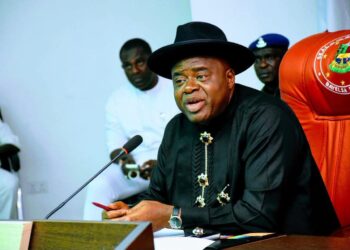
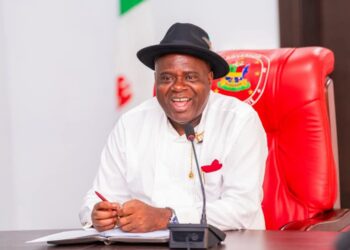
Diri Has Brought Honour and Pride to Bayelsa State and the Ijaw Nation
By Wisdom Oniekpar Ikuli, ABUJA – Since my appointment as Media Aide to His Excellency, the Very Distinguished Senator Douye Diri, Governor of Bayelsa State, I have never had the kind of encounter I experienced this morning.
While sleeping, I kept hearing the words, “Gov. Douye Diri has brought honour and pride to Bayelsa State and the Ijaw Nation,” repeatedly.
It felt like a dream, and after a while, the voice became louder and louder. When I woke up, it was 2 a.m. So, I tried to force myself back to sleep, especially because I was tired. But the experience became extraordinary.
Something that perhaps began in my subconscious at some point started ringing out. Eventually, it became obvious that I could not sleep unless I listened to the dictates of my subconscious mind.
Throughout literary history, numerous famous writers have experienced moments when their writing seemed entirely dictated by their subconscious minds.
The above phenomenon is often described as “automatic writing,” “hypergraphia,” or the flow state.
What usually happens at such times is that, instead of consciously planning their sentences, these writers report that words, characters, or entire plots flow into their minds so rapidly and effortlessly that they feel like mere stenographers recording an external voice.
As a writer, I have experienced this countless times, but my encounter this morning seems far more powerful.
A few days ago, I followed an online debate initiated by a renowned Yoruba writer and critic.
The debate revolved around the coastal road and challenged the perceived impossibility of developing the swampy and difficult terrain of the Niger Delta.
Even though the names of over 85 per cent of those who commented on the highly controversial piece clearly suggested that they were Yorubas, the vast majority celebrated the giant strides of Gov. Douye Diri of Bayelsa State. They compared his highly commendable achievements, particularly in road infrastructure, with those of some governors in the South-West and concluded that he had performed far better than most of his contemporaries in the current dispensation.
The geographical Niger Delta is unique. It is one of the deltas in the world, like the Ganges-Brahmaputra Delta in Bangladesh and India, which is the largest in the world; the Nile Delta in Egypt; and the Mississippi River Delta in the United States.
Others include the Mekong Delta in Southeast Asia, spanning Vietnam and Cambodia; the Danube Delta in Romania and Ukraine; the Indus Delta in Pakistan; the Lena Delta in Russia and Siberia; and the Irrawaddy Delta in Myanmar, among others.
The geographical Niger Delta, which covers Akwa Ibom, Bayelsa, Cross River, Delta, Edo, and Rivers states, is the area where the Niger and Benue rivers, along with other rivers, tributaries, creeks, and waterways, discharge their alluvial flows into the ocean.
The annual flooding and the eventual discharge of these waters into the ocean occur in Bayelsa State, which is the lowest-lying part of the country, with some areas below sea level.
For the record, there are two Niger Deltas: the geographical Niger Delta and the political Niger Delta.
While the geographical Niger Delta is a natural environment, the political Niger Delta was given its present administrative identity in 2000 when Chief Olusegun Obasanjo, GCFR, established the Niger Delta Development Commission (NDDC).
In order to secure the support of the South-East and South-West for the passage of the NDDC Act, Abia, Imo, and Ondo states were added to the region.
This development automatically gave the Niger Delta a new identity, making it synonymous with crude oil and gas production. Whereas the geographical Niger Delta has existed for thousands of years, crude oil was discovered in commercial quantities in West Africa at Oloibiri-Otabagi, in Ogbia Local Government Area of Bayelsa State, in 1956.
Over the years, successive administrations at both the federal and state levels used the excuse of difficult terrain to neglect the development of Bayelsa State, the only state in Nigeria with an exclusively Ijaw population.
At the inception of the ASSURED Prosperity Administration, 75 per cent of Bayelsa State could only be accessed through waterways, either by speedboats or local canoes.
There were no roads, and strong arguments were advanced to justify the situation. One example is the recent unwise and highly irresponsible statement by Donald Duke, the former Governor of Cross River State, that it was impossible to build roads in Bayelsa State because of the number of bridges required.
The story of difficult terrain was a slogan and a daily anthem before the ASSURED Prosperity Administration. However, Gov. Douye Diri decided to put an end to the deceptive narrative about difficult terrain.
The Nembe-Brass Road and the Yenagoa-Angiama-Oporoma-Otuan Road, in particular, were conceived in the early 1960s, but the excuse of difficult terrain was repeatedly used to frustrate the projects.
However, within six years, Gov. Douye Diri has successfully linked 75 per cent of Bayelsa State by road.
A visit to the Nembe-Brass Road, Angiama-Oporoma-Otuan Road, Ekeremor-Agge Road, and other projects speaks volumes about Gov. Douye Diri’s passion, courage, and extraordinary commitment to development.
It takes a visionary leader to accomplish what he is doing.
It is difficult to find a second-term governor who works with the intensity of someone campaigning for another term in office. Yet, this is the pace at which Gov. Diri is working.
Donald Duke never believed that a state governor could dredge and sand-fill kilometres of rivers and swamps to construct roads.
In many areas, it is like sinking an entire one-storey building into the ground before constructing the roads, in addition to building numerous bridges.
While the above may seem impossible to Donald Duke and others, Gov. Douye Diri not only made promises but has also successfully constructed many roads in the supposedly “difficult terrain.”
He has DEMYSTIFIED the deceptive narrative about DIFFICULT TERRAIN.
Gov. Diri has also brought unprecedented peace and unity among Bayelsans, irrespective of their political affiliations.
As governor, he ensures that no Bayelsan is denied any opportunity or benefit because of political party affiliation. He believes that people were Bayelsans first before becoming members of different political parties.
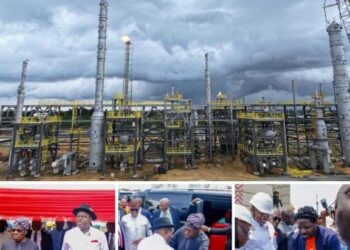
Before now, Bayelsa State was frequently in the news for negative reasons. Today, however, the state is not only adjudged to be one of the safest in the country but is also among the fastest-developing states.
The ongoing industrial revolution in the state is changing its hitherto established identity as a “civil service state.”
While my subconscious mind continues to echo the message that the great achievements of Senator Douye Diri have brought honour and pride to Bayelsa State and the Ijaw Nation in general, my body continues to protest because it has not had adequate rest.
In summary, I am very proud to witness the ongoing reformation, transformation, and repositioning of Bayelsa State on the glorious path of socioeconomic and political growth and development.
~~~ Chief (Hon.) Wisdom Oniekpar Ikuli, JP
Technical Adviser to the Governor of Bayelsa State on Media and Public Affairs.
27/10/2026.