Peter Obi Urges Nigerian Church to “Move from the Pulpit to the People” in Rebuilding National Values
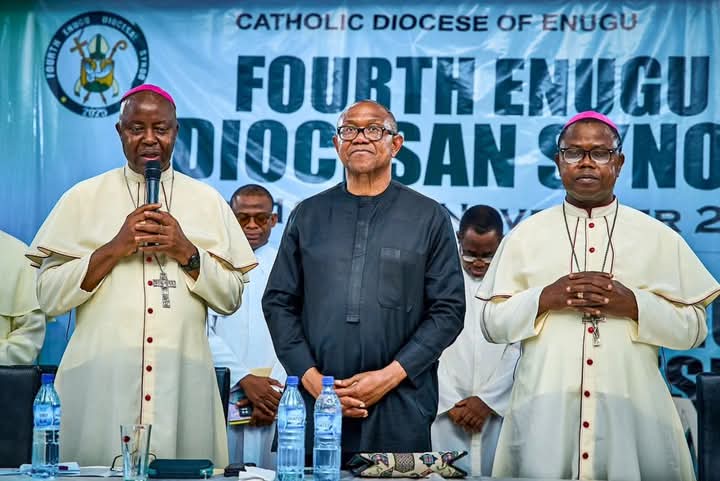
When the Fourth Enugu Diocesan Synod convened this week, its gathering of clergy and laity expected a sober reflection on doctrine, service, and the state of the nation. What they received instead was a passionate call to action from former Anambra State Governor Peter Obi—one that challenged the Church to step beyond familiar routines and take on a more grounded, transformative role in Nigeria’s social renewal.
Fresh from a trip abroad, Obi attended the synod as a guest speaker, delivering an address titled “The Role of the Church in Youth Empowerment and Community Development.” But the essence of his message stretched far beyond the walls of the cathedral. With unmistakable urgency, he told the assembly that Nigeria could no longer afford a faith community that remained confined to sermons. To him, the Church’s next defining mission must be to move from the pulpit to the people.
A Nation in Moral Freefall
Obi highlighted what he described as a deepening crisis of values—one he believes is at the heart of Nigeria’s socio-economic troubles. While other nations leverage knowledge, innovation, and discipline to build stable societies, Nigeria, he argued, is being eroded by “alarming levels of valuelessness, moral decay, rising rascality, and a diminishing sense of responsibility.”
According to him, the country’s failures are not due to ignorance but to the collapse of ethics. “Shortcuts are celebrated, dishonesty is rewarded, and integrity is sidelined,” Obi lamented, noting that even the highly educated—including professors—have not been spared from the decline in moral standards.
For Obi, these trends represent a societal emergency. And such emergencies, he insisted, demand moral leadership—precisely the kind the Church was historically designed to provide.
The Church as Society’s Moral Compass
Obi’s message was not accusatory but restorative. He described the Church as an institution with “the moral authority and structural reach” to guide Nigeria back to a path of responsibility and character.
At the synod, he painted a picture of a Church capable of spearheading transformative, people-centered initiatives:
- Skills acquisition programmes that give young people practical means to build livelihoods.
- Mentorship structures that instill discipline, ethics, and resilience.
- Sustainable community development projects that strengthen social systems.
- Consistent engagement with local communities to address real-world challenges.
Faith, he argued, must translate into tangible opportunities—especially for young people facing unemployment, disillusionment, and a constant barrage of negative societal influences.
From Sanctuary to Society
For Obi, the essence of Christianity extends far beyond delivering sermons or hosting sacred ceremonies. It lies in shaping conduct, nurturing values, and building communities where responsibility and honesty are rewarded.
He reminded the synod that the earliest Christian missions in Nigeria were not known merely for preaching—they established schools, health centres, vocational institutes, and social systems that held communities together. That model, Obi said, must be revived for the country to stand a chance at meaningful renewal.
“By moving from the pulpit to the people,” he said, “the Church can inspire a new generation and play a decisive role in rebuilding Nigeria’s values, morals, and national character.”
A Call That Resonates Beyond the Church
Obi’s message arrives at a time when Nigerians across all strata are searching for leadership that transcends politics. Many see faith institutions as the remaining structures capable of fostering unity, purpose, and moral clarity.
His call for the Church to reclaim its place as society’s ethical backbone adds to a growing discourse on the role of non-state actors in national development. In framing value restoration as a collective responsibility, Obi has placed the Church at the centre of a conversation that touches education, governance, economy, and identity.
A Vision for Renewal
In the end, Obi’s address was not simply a critique; it was a blueprint for hope—a reminder that communities flourish when values are preserved and young people are empowered.
For a nation confronting moral uncertainty, his message offers a path anchored not in politics, but in shared responsibility between institutions and the people they serve.
Whether the Church will take up this challenge remains to be seen, but one thing is clear: Obi has reignited a conversation about moral leadership at a moment Nigeria desperately needs it.