Diri: Bayelsa Has Moved Beyond Terrain Barriers At 30, Darah Calls For Resource Control, Economic Diversification
By Jonah Fubara, YENAGOA — Thirty years after its creation, Bayelsa State has moved significantly beyond the geographical and infrastructural barriers that once constrained its development, Governor Douye Diri has said.
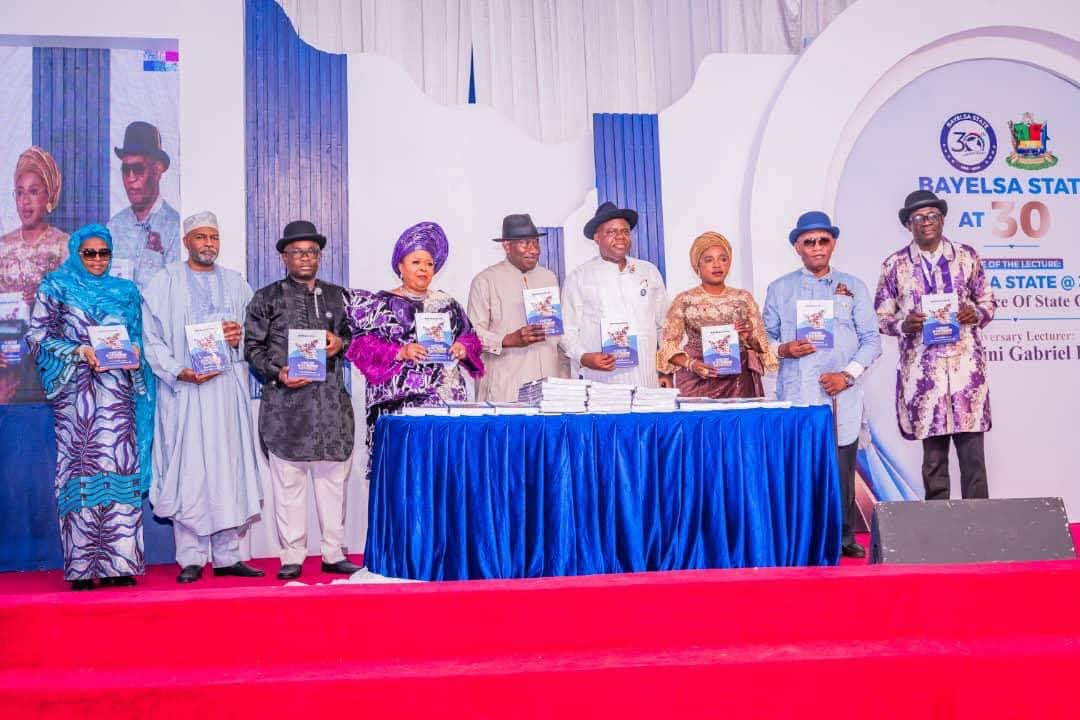
Diri made the assertion on Wednesday at an exhibition and anniversary lecture organised as part of activities marking the 30th anniversary of the state at the DSP Alamieyeseigha Memorial Banquet Hall, Government House, Yenagoa.
The governor said Bayelsa, created on October 1, 1996, was confronted at inception by difficult terrain, poor connectivity, inadequate infrastructure and a weak economic base, but successive administrations had gradually changed the development landscape.
According to him, the transformation is reflected in the construction of roads and bridges linking previously isolated communities, the establishment of universities and other institutions, and the development of an international airport.
“Today, where there was once swamp, we have an international airport. Where there were once creeks, we now have five universities as well as polytechnics. Where communities were separated by water, bridges and roads now bind us together,” Diri said.
He also noted the growing presence of federal institutions in the state, citing the Content Towers, Federal Secretariat, Nigerian Law School and various security formations as evidence of Bayelsa’s expanding institutional footprint.
Diri said the progress recorded in the past three decades should be viewed as a collective achievement built on the contributions of successive administrations, leaders and citizens.
He disclosed that his administration was renewing attention to the state’s senatorial roads, while the Independent Power Project was being expanded from 60 to 100 megawatts.
The governor also listed the ongoing construction of a 30,000-capacity stadium and a nine-storey Secretariat Complex among projects expected to support public service delivery and economic activities.
Beyond infrastructure, Diri said the next phase of Bayelsa’s development must focus on stronger institutions, opportunities for young people and women, environmental protection and equitable development across the state.
He urged Bayelsans to turn the sacrifices of those who fought for the creation of the state into a foundation for a stronger future.
“The legacies of yesterday must become the launchpad for the Bayelsa of tomorrow: a Bayelsa that is more connected, more prosperous, more just, more peaceful, and more promising for every citizen and resident,” he said.
Darah: Oil And Gas Have Constrained Nigeria
Delivering the anniversary lecture, renowned scholar and public intellectual, Prof. Godini Darah, turned attention to Nigeria’s dependence on petroleum resources, arguing that excessive reliance on oil and gas had constrained the development of other productive sectors.
Darah called for reforms to Nigeria’s fiscal federalism and greater resource control for oil-producing regions.
He described the 13 per cent derivation allocation to oil-producing states as “87 per cent deprivation,” arguing that the Niger Delta continues to bear the environmental costs of petroleum extraction while exercising limited control over its natural resources.
He traced the situation to historical and constitutional arrangements, including Petroleum Decree Number 51 of 1969 and Section 44(3) of the 1999 Constitution.
The scholar challenged Niger Delta leaders to reduce dependence on crude oil by investing in knowledge, science, technology, research and industries capable of adding value to the region’s resources.
He advocated specialised universities and research institutions focused on areas such as oceanography, marine engineering and commercial aquaculture.
Darah also called for the conversion of natural gas into reliable electricity and the development of petrochemical and other industries capable of creating jobs and generating wealth within the Niger Delta.
He urged state governments and Host Community Development Committees to deploy funds provided under the Petroleum Industry Act to human capital development and transformative infrastructure.
The academic further encouraged greater use of local resources, including clay, in construction and industrial production.
He urged Bayelsans to use the 30th anniversary to renew their commitment to the development of the state while strengthening national unity.
The anniversary programme featured a panel discussion moderated by the Vice Chancellor of the University of Africa, Toru-Orua, Prof. Solomon Ebobrah. Participants included Prof. Ibaba Samuel Ibaba of Political Science, Young Ayotamuno and Prof. Ongoebi Maureen Etebu, Nigeria’s first female professor of mechanical engineering and former Commissioner for Special Duties.
An exhibition chronicling Bayelsa’s history, the struggle for its creation and the state’s developmental milestones over three decades was also held.
Former President Goodluck Jonathan and his wife, Dame Patience Jonathan; the governor’s wife, Dr. Gloria Diri; Deputy Governor Dr. Peter Akpe; and members of the family of the late former Head of State, Gen. Sani Abacha, including Mohammed Abacha, Abba Abacha and Fatima Gumsu Abacha, attended the event.
National Assembly members, state legislators, government officials, traditional rulers and other Bayelsans were also present.