From Palace Boy To King: The Story Of Sir Godwin G. Igodo
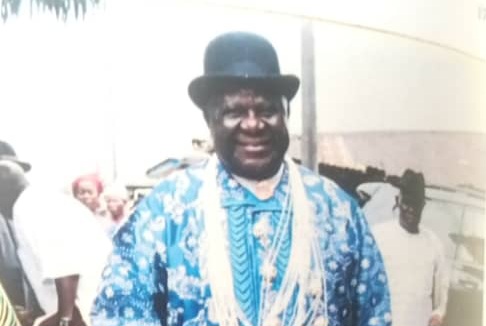
By Enideneze Etete – The adage, “A child who washes his hands clean dines with kings”, foretells the future of gifted and well-behaved children. This timeless adage captures the story of HRM (King) Godwin Gurosi Igodo, JP, KSC, who exuded decorum, humility, hard work and respect, from childhood to later years.
His meteoric rise to kingship, could be attributed to close ties with elders and kings, such as his maternal uncles, Chief Omele Tologere, Chief G. F Omele, King M B. W Mabinton and King Fredrick Abiye Agama, whom he served diligently.
His services in King Mabinton’s palace, earned him the Monika, Palace Boy. This signaled his later elevation to the throne, succeeding his master, King Agama.
Godwin’s kingship was also rooted in his paternal family’s royalty. His great-grand father, Chief Omonowe Igodo, was Ebeniken (Paramount Ruler) of Obogoro community, through gerontocracy. Godwin’s father, Chief Gurosi Igodo also became Ebeniken of the community in same manner.
Godwin continued the royalty, starting as Ebeni-Pele (Compound Chief) of Yenikwe, and later elected as Ebeniken of Obogoro in 1975. He ruled for 30 years, served as Secretary and Spokesman of Atissa Council of Chiefs during the reigns of King Mabinton and King Agama, respectively.
He was later enthroned as Ebeni-Utobo (Sub-clan Head), and subsequently elected as Ebenibe (Clan Head) of Atissa Kingdom in 2005, to succeed late King Agama.
In all, King Godwin’s traditional leadership spanned six decades, reaching the zenith as Chairman, Traditional Rulers Council of Bayelsa State, from 2012 to 2014.
Born in 1934, Godwin was well-groomed by his agrarian parents, Chief Gurosi Igodo, who also worked in UAC, Yenagoa Trading Post, and Mrs. Aprebogha Matilda Igodo, NEE Omele of Yenaka.
His parents enrolled him in St. Peter’s School Yenagoa, in 1943, where he schooled until Standard Four, and travelled to stay with an uncle, before returning to finish Standard Six, ranking among few that passed the FSLC in 1949.
Thereafter, his maternal uncle, Fredrick Agama who then was a tutor picked interest in the young chap. Thus, Godwin began secondary school education in Okrika Grammar School (OGS) in 1950, later moved to various schools in the then Eastern Region where Agama was tutor.
Notable among them are Okrika Grammar School (OGS), Church Missionary Society (CMS) Grammar School, Prince Commercial Institute, all in Onitsha, and Aggrey Memorial Secondary School, Arochukwu where his tutor-uncle served, respectively.
His post-primary education had a hiatus, he could not continue because Agama left Prince Commercial Institute Onitsha, for London in 1954.
Undeterred, Godwin Gurosi Igodo took a quicker route to education and work career. He registered for private London General Certificate Examination (GCE) in 1965, and Royal Society of Arts (RSA), which he passed.
With these qualifications, he became a teacher in Apostolic Faith School, Olokuma-Ahoada in 1955, fulfilling his mother’s wish to have a son in the respected profession.
After a year, he left the teaching job, having secured employment as a administrative and clerical typist in the colonial Central Ijaw County Council, Yenagoa, as pioneer staff.
Besides role of interpreter, he also handled clerical-accounting duties for the then popular Treasurer, J. C. K Ogorode of Amassoma. He left the service as senior clerk in the Brass Province, in 1959.
Soon after, the Eastern Wrougth Iron Company in Port Harcourt employed him; and he later rose to director from 1979 to 1982.
In 1961, he was recruited by the Nigerian Ports Authority (NPA), Port Harcourt through his friend, Eddy Porbeni who was a staff. The Nigeria-Biafra Civil War, which erupted in 1967, disrupted operations, thus, he did not return to the NPA after the war.
In the private sector, he worked as depot supervisor in Pecca Marine Nigeria Limited, Port Harcourt, an oil serving company owned by King Fredrick Abiye Agama, which rendered services to Shell and other clients.
With the private sector experience, he established G. Godwin Igodo & Sons Nigeria Limited, and Tariebi Trading Company. His companies prioritized effective delivery of services to public and private clients, sometimes completing agreed milestones with personal funds, before payments.
While as traditional ruler, government engaged him as a Member of Advisory Committee for Yenagoa City Development Master Plan; Chairman and Judge in Customary Court, Onopa, and Member, Local Government Election Tribunal.
King Godwin Gurosi Igodo’s traditional leadership of six decades, was characterized by unity and progress in Obogoro, the once-small community, and the Atissa Kingdom.
A charismatic leader, his peaceful nature, catchword of “Babokie” (Leave it, Forgive), selfless, transparent and participatory approach to leadership. He prioritized consulting stakeholders and sharing responsibilities to various committees. His leadership style bound the people together, for a common goal.
In his reign, the Atissa Council of Chiefs was enlarged with more Sub-clan Heads (Oda-Otubos), traditional title holders, Women Chiefs (Oda-Ifinas), Community Development chairmen and youth leaders, occasionally.
Atissa Kingdom’s constitution and traditional protocols were streamlined and enforced; New Yam Festival (Uge Adiafa) was re-branded and sustained, besides a mega Festival (Uge Gene), jointly celebrated with Epie Kingdom to reinforce unity of the twin clans and re-enact historical and cultural affinities.
The soft-spoken and diplomatic monarch, unequivocally demanded a fair deal for his Kingdom, Yenagoa City, Bayelsa State and the Niger Delta, at various forums and through letters to governments at various levels.
His concerns were usually creation of more wards, constituencies, local government areas, municipal council status for Yenagoa, sustenance of indigenous languages and cultures, aggressive development of the state capital, industrialization, youth empowerment, and security.
Others include good governance, Epie gubernatorial ticket, constitutional role for traditional rulers, environmental degradation, and coastal erosion in Obogoro and Famgbe.
As Chairman of traditional rulers council in Bayelsa State, King Godwin Igodo, provided transparent and inclusive leadership, carrying his colleagues along; demanded better welfare and respect for traditional rulers, classification of more traditional stools, and played advisory roles to government.
In religion, he was a member of St. John’s Anglican Church, Obogoro, right from childhood, following his parents pioneer membership and donation of a mud-hut for take off of the church in the community. He was knighted as Knight of St. Christopher (KSC).
King Igodo’s life was not only a smooth ride; he had tough times, but took them with equanimity; notably his abduction on September 1, 2011 by men of the creeks who held him captive for 27 horrifying days.
He died on February 27, 2025, at age 91, leaving behind two wives: Mrs. Rose Nwakaego Igodo and Mrs. Ketty Igodo; 11 children who are in different professional callings, and many relatives.
The funeral of the late King Igodo began November 24, 2025 and ends December 2, 2025, amid celebration for his life of public service.
As Obogoro community, Epie-Atissa, Bayelsans from all walks of life pay him last respect today, November 28, 2025, and his remains interred, the passing of HRM (King) Godwin Gurosi Igodo, JP, KSC, Ogbotom Edede the VII, is indeed the passage of an era of kingship.
Rest in perfect peace. Adieu, the Bridge Builder and Peacemaker. Adieu.