Rising Voices, Rising Futures: How a 16-Year-Old’s Triumph Reflected the Power of Local Content Education
By Victor Oroyi – When 16-year-old Josephine Oyinkansola Akande stepped into the Nigerian Content Tower in Yenagoa, she was just one of ten nervous finalists hoping their ideas would stand out. By the end of the day, she left as the youngest-ever champion of the NCDMB Annual National Undergraduate Essay Competition—an achievement that echoed far beyond the N1 million prize and the applause that greeted her name.
The 200-level medical student from Obafemi Awolowo University had written her way to the top of a fiercely contested ninth edition of the competition, outperforming older finalists and reaffirming the potential embedded in Nigeria’s youth. Her win became the emotional high point of a ceremony that celebrated not just academic brilliance, but the broader vision of nurturing a generation that understands the economic value of local content and its place in Nigeria’s evolving energy landscape.
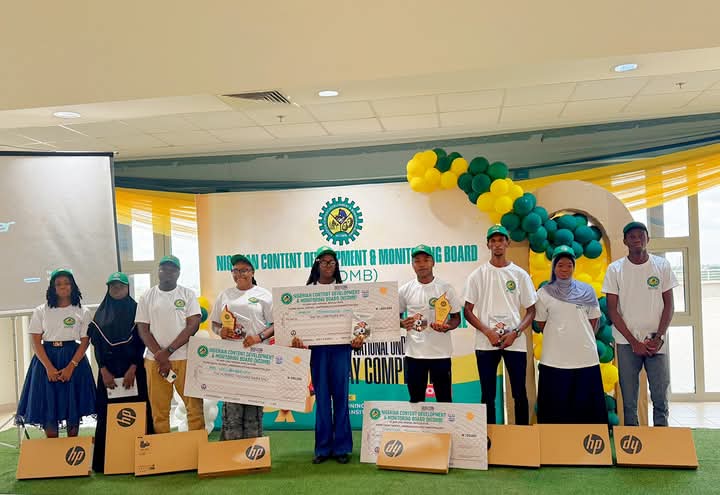
Her triumph was followed closely by that of 23-year-old Sonuga Sultan Opeyemi, a medical student from FUTA who claimed second place, and 200-level computer science student Amarachi Precious Aguigwe from the University of Uyo, who placed third. But the excitement in the hall extended to every finalist—each receiving an HP laptop and copies of Nigeria’s Local Content: A Journey of Strategic Communication and Economic Transformation, a book that has become a symbolic companion in the Board’s educational initiatives.
The real essence of the event, however, unfolded in the reflections shared by leaders, academics and programme partners who see the competition as a transformative national investment. In his keynote address, the Executive Secretary of the Nigerian Content Development and Monitoring Board (NCDMB), Engr. Felix Omatsola Ogbe, explained why the Board has sustained the competition for nearly a decade. Local content, he emphasised, is not just a policy framework but “an economic imperative” central to Nigeria’s sustainable development—especially as global conversations advance rapidly toward energy transition.
Through essay writing, the Board aims to empower students with analytical depth, creativity and critical-thinking skills—competencies increasingly indispensable in a digital, knowledge-driven economy. Ogbe, represented by Mr. Teddy Bai, reminded the gathering that the competition serves as a bridge between education and national priorities, ensuring young people understand and can articulate the stakes of Nigeria’s evolving oil and gas industry.
Programme consultant and CEO of Mahogany 21st Century Concepts, Mr. Eyinimi Omorozi, captured the sentiment when he lauded the Board’s unwavering commitment. For him, the competition has matured into a respected intellectual platform that challenges students to engage meaningfully with national issues. The transparency of the judging process and the enthusiasm of participants, he noted, reflect a model worth sustaining.
Academic voices added further weight to the celebration. Professor Barclays Ayakoromo, serving as chairman of the occasion, highlighted how the programme enriches the academic development of undergraduates across the country, promoting writing culture and intellectual curiosity in a generation often shaped by digital shortcuts.
For Dr. Obinna Ezeobi, General Manager of Corporate Communications at NCDMB, the essay competition remains a testament to the Board’s dedication to capacity building. Even while represented by Mr. Teleola Oyeleke, his message was clear: excellence must be encouraged, rewarded, and nurtured. His charge to the finalists—to keep challenging themselves—summed up the spirit of the event.
More than the speeches, what lingered in the minds of observers was the diversity and determination of the finalists, who came from universities across Nigeria and represented varied disciplines—from pharmacy and engineering to computer science and medicine. Each student, including Josephine, carried a story of grit and intellectual ambition.
For the young winner, her victory symbolizes possibility. For the NCDMB, it represents continuity. And for Nigeria, it hints at a future where informed, articulate, and visionary young citizens sit at the heart of conversations about national development.
As the ceremony closed and the students gathered their prizes, one thing was unmistakable: the power of ideas is still shaping destinies—and the NCDMB essay competition is ensuring those ideas do not go unheard.