Unwrapping The Bridge Builder: Memoirs of a King and His Life
By Etete Enideneze – Growing up in the service and tutelage of the Omeles, Mabintons and the Agamas, as his uncles, young Godwin Gurosi Igodo imbibed the wisdom of these leaders. He learnt the history, traditions and customs of Epie-Atissa from these sages and custodians of the twin kingdoms.
One remarkable habit Godwin tapped from them, is the art of recording events in diaries, for future reference.
Years after, the art of documenting his personal and societal events, propelled him to tinker over writing an autobiography to preserve his history, having accumulated much information.
This mission was however, not to be achieved in a hurry because subsequent events have to be captured, and facts must be properly checked. More so, an autobiographical book of a king would be seen as authoritative, thus, the content has to be objective and credible.
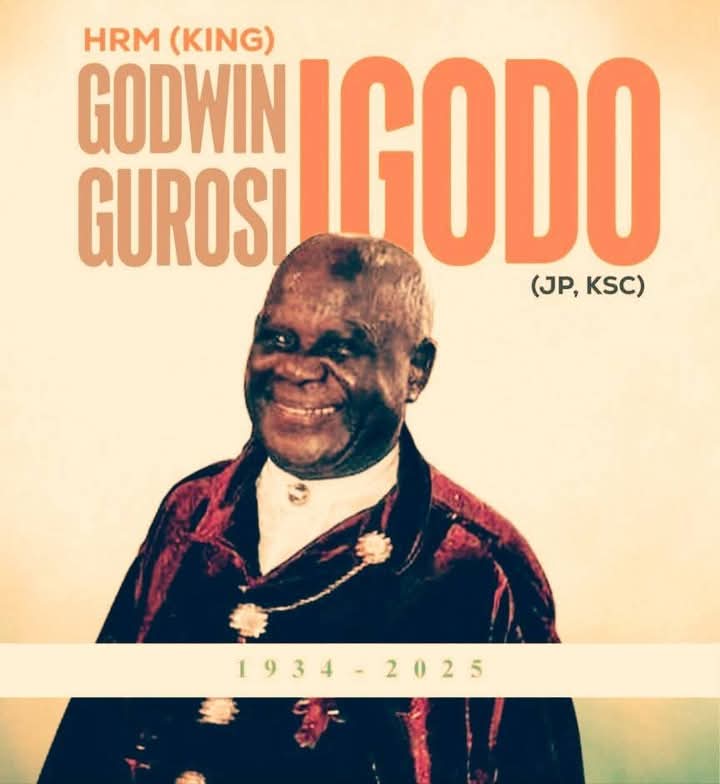
Therefore, HRM (King) Godwin Gurosi Igodo, JP, KSC, took the challenge to write his biography meticulously. He took time out of his busy schedules as Ebenibe, Ogbotom Edede VII of Atissa Kingdom, and while as Chairman of Bayelsa State Council of Traditional Rulers, to dust up his diaries and fleshed up facts into a book manuscript.
The effort which spanned years, was further slowed by inquiries into archival records, oral traditions and interviews to gather more facts and put them in right perspectives.
Though he targeted publishing the autobiography for unveiling, on his 90th birthday celebration, the target was not achieved. This was due to the need for more information and cross checking of vital facts that kept emerging. A feeling that publishing an autobiography at old age is often misperceived as a signal to departing the world soon after, also deterred him.
The precious project again suffered a setback, when he began to have age-related eyesight problem. Determined to realize the project, his script had to be read to him in course of making series of corrections, while new information that popped up were added. This, and the prodding from his children, encouraging him not to give up, sustained the manuscript development process.
Incidentally, men of the underworld kidnapped him on September 1, 2011, causing another constraint in the book project. Ironically however, the kidnap incident spurred him to complete the manuscript work.
Creatively, the horrifying experience of his abduction, and 27 days captivity in the kidnappers den, and a staggering ransom tagged for his release, and how he regained freedom, form the first, second and third chapters of the book.
The 13-chapter autobiography, titled, The Bridge Builder: Memoirs of My Life and Kingship, is uniquely structured in reversed-chronology style: starting with the most recent events, and ending with the remote ones.
Despite this approach, the chapters reflect the stages of his life, linked to sub-themes, with his early life taking the last chapters.
The sub-themes, anchored on the autobiographer’s main theme of a “Bridge Builder”, a de-triabalized leader and peacemaker, seamlessly connect the chapters. This structural arrangement and linkages, make it easy to read the book from beginning to end, with rapt interest.
Alternatively, each part or chapter provides interesting accounts which could be easily read as distinct narratives.
The lucid grammar, lively prose and proverbs sprinkled across 226 pages, besides historical pictures also make the autobiography an interesting read.
In chapter 4, the author states how he emerged as Chairman, Traditional Rulers Council of Bayelsa State, leadership style and achievements on the position, from 2011 to 2013.
Chapters 5 to 7, focus on the environment, history, customs, traditions, local economy and contemporary developments in Obogoro, Yenagoa City, Atissa and Epie kingdoms; how he started traditional rulership from compound chief to paramount ruler and to enthronement as a king. He in part, objectively states the challenges and achievements of his reign as Ebenibe of Atissa Kingdom.
The latter chapters in the book dwell on his early life, family, education, religion and work career in different spheres.
Another interesting feature in The Bridge Builder, is the expansion of content beyond the author’s personal life and locality. The author dovetails but coherently connects narration of his personal events to colonial, regional and national incidents and issues. In this regard, he emphasizes the impacts of British colonialism; Nigerian-Biafran Civil War; neo-imperialism; Nigeria’s skewed federalism, political economy of crude oil and gas, environmental degradation; insecurity; moral decadence; non-constitutional role for monarchs, and lots more.
Edited by seasoned journalists and scholars, and published by The Newzmarshal Publication, Lagos, the foreward is written by the author’s colleague, King Alfred Diete-Spiff, who glowingly recommends the book for all class of persons.
Indeed, King Igodo’s autobiography, written from his work experience in the colonial to post-colonial eras, and traditional leadership, which traversed six decades, is a viable resource for present and future leaders, as well as scholars.
As a personal account of his lifetime and experiences, written in first person narrative, hence the content might be taking as the authorial voice has spoken, one could only call for addressing some literals (typos) in subsequent reprint of the book.
The long-awaited autobiography, which publication was delayed by obvious reasons, and the author could not witness, will be presented to the public on Tuesday, November 25, 2025, in Goodluck Jonathan Hall, Azaiki Public Library. The event, slated for Noon, will attract dignitaries from all walks of life.
Admiral Gboribiogha John Jonah (Rtd), former deputy governor of Bayelsa State, will chair the occasion, while Prof. Nimibofa Ayawei, Secretary to Bayelsa State Government, is Chief Special Guest of Honour, with King Bubaraye Dakolo, Chairman, Bayelsa State Council of Traditional Rulers as Royal Father of the Day, among other guests.
The book will be reviewed by Prof. Steve Sinikiem Azaiki, while Chairman of Yenagoa Local Government Council, Hon. Bulodiseye Ndiwari is the Chief Host.
Though gone, HRM (King) Godwin Gurosi Igodo, JP, KSC is alive in his magnum opus autobiography, which preserves his legacies for present and future generations.
This book review, written by Enideneze Etete, runs as spotlight on Radio Bayelsa, Glory FM 97.1, today.