ABER Seeks China Partnership to Advance Africa’s Blue Economy, Delta Governance
By Tams Jonah, ABUJA – The Africa Blue Economy Roundtable (ABER) has proposed a strategic partnership with China to strengthen river basin management, coastal protection and delta governance across Africa, including the establishment of a joint knowledge hub in Nigeria.
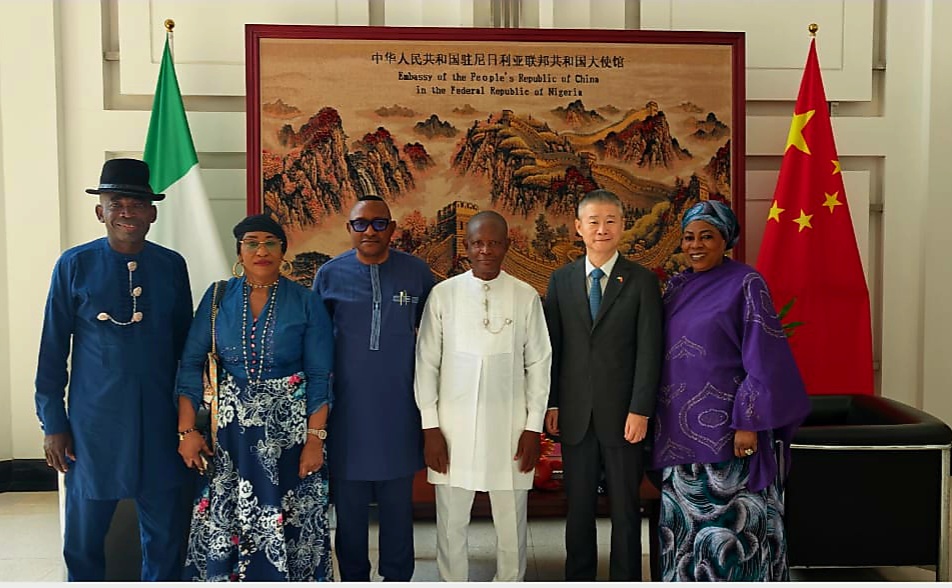
The proposal was presented on Wednesday in Abuja when a delegation led by ABER’s Convener and Founder, Dr. Piriye Kiyaramo, met with the Chinese Ambassador to Nigeria, H.E. Yu Dunhai, represented by Sun Xuekun, Counsellor in charge of the Embassy’s Economic and Commercial Office.
During the meeting, the Chinese government expressed readiness to explore cooperation with ABER and relevant institutions through the appropriate diplomatic channels, reaffirming China’s interest in sustainable delta development, coastal Exclusive Economic Zone management and ocean literacy.
The Chinese representative highlighted China’s maritime and commercial interests in Nigeria and Africa, citing its involvement in ports, railways, free trade zones and maritime logistics.
He also reaffirmed China’s commitment to strengthening cooperation with Nigeria in river basin management, coastal protection, delta governance and capacity building under the Forum on China-Africa Cooperation (FOCAC).
The meeting was facilitated by ABER as part of its efforts to mobilise South-South cooperation, policy advocacy and investment in Africa’s blue economy.
Speaking during the visit, Kiyaramo commended the Chinese government and East China Normal University (ECNU), Shanghai, for launching the China-Africa Cooperation on River Basins, Coastal Zones and Delta Governance, describing the initiative as a significant step towards addressing Africa’s interconnected environmental and development challenges.
He said ABER, a Pan-African platform comprising more than 400 maritime experts, academics, industry leaders and seafarers across 25 coastal states and the Diaspora, was positioned to connect scientific research with policy development and community action.
Kiyaramo outlined ABER’s contributions in policy advocacy, research and data development, community inclusion and continental collaboration through its Identify, Protect, Harness (IDP-H) framework.
He said ABER had championed the development of Nigeria’s first National Policy on Marine and Blue Economy, approved in May 2025, and was advocating a complementary national framework for river basin and delta governance.
The organisation also proposed an ECNU-ABER River-Delta Knowledge Hub to be established in Nigeria to support joint research, river monitoring stations along the Niger and Benue rivers, and training for hydrologists.
According to Kiyaramo, the proposed hub would help address Africa’s shortage of baseline data on river-to-sea systems and strengthen evidence-based decisions on coastal and delta development.
He stressed that effective ocean management must begin with the rivers that feed it, noting that pollution, ecosystem degradation and coastal erosion require integrated approaches rather than isolated interventions.
“We have discussed Blue Economy as a sea economy. Yet 60% of marine pollution comes from rivers, and 70% of fish breed in deltas. You cannot govern the sea without governing the river that feeds it. ECNU has understood this nexus,” he said.
Kiyaramo warned that African river systems, including the Niger, Benue and Congo, faced mounting environmental pressures, while coastal communities continued to contend with erosion, climate change, resource exploitation and poverty.
He also highlighted ABER’s Africa Blue Ocean Guardians initiative, which engages young people in coastal protection and promotes the involvement of women fish processors, fishermen and delta youths in monitoring river health and supporting sustainable development.
Beyond Nigeria, he said ABER intended to use its continental network to extend the ECNU collaboration model to other major river and delta systems, including the Senegal River Delta and the Congo Basin.
To advance the proposed partnership, ABER outlined three key initiatives: designating the organisation as Nigeria’s implementing partner for ECNU’s Africa programme; establishing a China-Africa River-Coast-Delta Fellowship to support 20 African scholars annually at ECNU; and convening an Abuja-Shanghai Delta Governance Dialogue in Yenagoa as part of ABER’s proposed Gulf of Guinea Blue Economy Media Summit.
The proposed dialogue would bring together the Chinese Embassy, ECNU and relevant African stakeholders to explore practical approaches to river basin management, coastal resilience and sustainable delta development.
Kiyaramo said the proposed collaboration would help translate China-Africa diplomatic relations into practical cooperation on shared environmental and economic priorities.
The visit ended with both parties agreeing to deepen technical engagements towards a formal ABER-China partnership framework.
Members of the ABER delegation included Dr. Amenya Kartay, Chief of Staff and Head of Abuja Liaison Bureau; Hajiya Medina Dauda Nadabo, Director of Communication and Public Affairs; Prince Ibiok, Director of ICT and Digital Innovation; and Celina Momoh, Special Assistant to the Convener and Founder on Protocol.